

Young AFK
The Working Group Junge AFK is aimed at researchers who position themselves within the interdisciplinary field of peace and conflict studies. In this context, “young” researchers means scholars of all generations who have only recently begun working in this research field. The working group seeks to reduce hierarchies between established and less established researchers in peace and conflict studies. Researchers are encouraged to freely develop their own perspectives within the field and to fruitfully contrast their research with established concepts, theories, and methods.
The spokespersons of the Junge AFK working group are:
Myriel Mathez, Yuri Natali Tarache Piñeros, Katharina Storch, Mascha Liening
Contact
Connect with us on LinkedIn so you don’t miss any news from Junge AFK!
Upcoming Events of Junge AFK
Conference of Young AFK 2025
“From Fake News to Cyberwar: Current Challenges and Approaches in Peace and Conflict Studies”
From March 18 to 19, 2025, the Junior Working Group of the AFK will once again host its Nachwuchstagung (early-career conference). Under the heading “From Fake News to Cyberwar: Current Challenges and Approaches in Peace and Conflict Studies,” we invite you to jointly discuss aspects of global, political, and societal questions. The conference takes place ahead of the AFK Colloquium 2025 and is aimed at researchers and students from the interdisciplinary field of peace and conflict studies, as well as people from non-academic fields.
With the Nachwuchstagung, we offer a platform for discussion of ongoing or completed master’s theses and doctoral projects, as well as emerging research ideas or creative formats.
Possible topics for your contributions include, among others:
Current wars and conflicts
Fake news, cyberwar, and the role of AI
Civil conflict resolution and peacebuilding
Social movements and protest research
Armament and disarmament as well as arms control
Feminist theories in peace and conflict studies
Peace education and peacebuilding
Methods in peace and conflict studies
More information can be found in our Call für Paper. Contributions can be submitted in German or English.
If you are interested, please send an abstract of your contribution or format to jungeafk@gmail.com by November 17, 2024. We look forward to your ideas!

The conference was funded by the Deutschen Stiftung Friedensforschung (DSF) . The conference report can be viewed here.
Past Events of the Young AFK
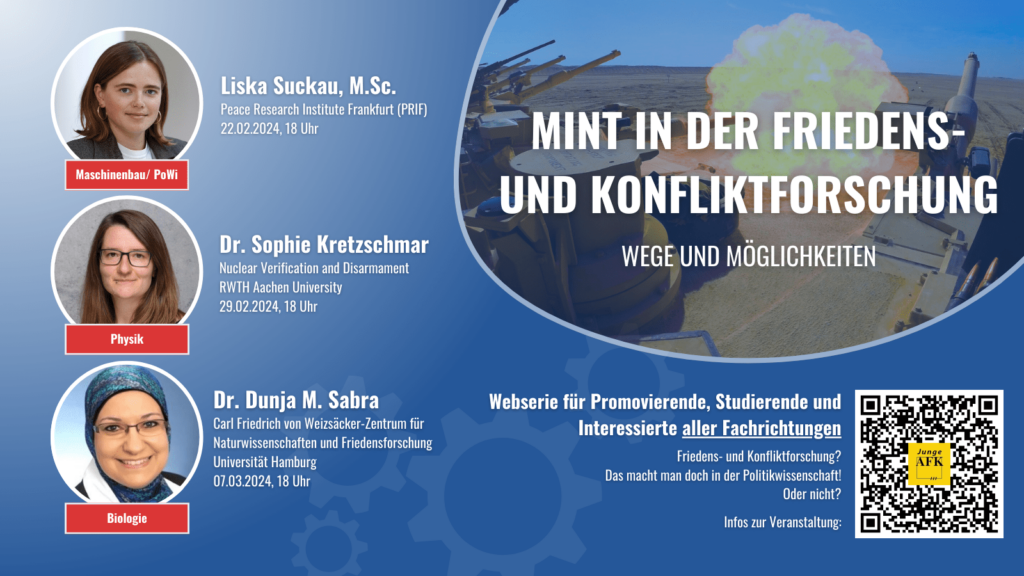
What does STEM do/can do in Peace and Conflict Studies? (Three-part web series)
- Liska Suckau, M.Sc. ⇒ 22.02.2024, 18 Uhr
- Dr. Sophie Kretzschmar ⇒ 29.02.2024, 18 Uhr
- Dr. Dunja M. Sabra ⇒ 07.03.2024, 18 Uhr
Conference of Young AFK 2023
The Young Researchers Conference of the AK Junge AFK (Working Group of Young Researchers of the German Peace and Conflict Studies Association) took place on March 29–30, 2023 in Berlin Spandau in cooperation with the Akademie Villigst. The conference focused on the topic of inter-, trans-, and multidisciplinarity in peace and conflict research and its adjacent fields. The goal was to incorporate as many diverse perspectives as possible regarding participants and their fields of work, shedding broad light on the questions arising from this thematic focus.
While classical peace and conflict research has traditionally concentrated on the study of international conflict dyads, over recent decades it has increasingly expanded to include topics that go beyond the perspectives of political science and international relations. Today, it also embraces approaches from psychology, sociology, anthropology, as well as technical natural sciences like geography and climate research.
Besides the keynote speech by Deborah Düring (Member of the German Bundestag, Bündnis 90/Die Grünen), which addressed interdisciplinary and cross-sectoral integration in times of multiple crises (particularly in active politics) and the relationship between science and politics, the conference featured six different panels. These panels, on the one hand, engaged with peace and conflict research topics from different disciplinary perspectives (e.g., in the contribution “Knowledge politics in climate securitisation: framing strategies and the reconceptualisation of peace during exacerbating climate destabilization” by Dario Pagnia). On the other hand, some panels focused actively on the tasks, possibilities, and limits of inter-, trans-, and multidisciplinarity (e.g., in the contribution “Have more interdisciplinarity! On the future of the interdisciplinary claim including natural science and technical peace and conflict research” by Linda Ostermann or through the workshop discussion “Interdisciplinary Writing and Publishing” by the Uneins Magazine).
During breaks and informal gatherings in the evening, interesting connections and conversations emerged among participants from diverse backgrounds, fostering cross-disciplinary exchange beyond the formal panel discussions.
Conference of Young AFK 2020
From March 11 to 12, this year’s Young Researchers Conference of the Junge AFK will take place in Schwerte under the theme “Radicalization and Collective Violence.”
The conference addresses the topical and socially relevant fields of radicalization and collective violence. Among other questions, it seeks to explore: What is the relationship between processes of radicalization and collective violence? Is radicalization an obstacle for democratic societies that requires preventive measures?
Current events and developments such as the peace process in Colombia or the emergence of social movements like the Yellow Vests in France are part of the program and provide interesting points of connection for a broad audience. The development of societal radicalization in recent years can be traced along the conference program as an example. As in previous years, the conference brings together various research traditions and disciplines. The presentation of academic research results will take place in classical panel sessions. Opportunities to link science and practice will be provided especially in workshops. An open exchange will be facilitated through a fishbowl discussion, and a keynote will ensure a connection to current debates in research.
The conference synthesizes findings from different disciplines on radicalization as well as prevention and deradicalization work. It aims to encourage exchange between young scholars and practitioners. The Junge AFK focuses on networking early-career researchers within the German-speaking region and internationally.
While classical peace and conflict research has focused strongly on international conflict dyads, over the past decades it has increasingly expanded beyond the perspectives of political science and international relations, now encompassing approaches from psychology, sociology, anthropology, as well as technical natural sciences like geography and climate research.
Besides the keynote by Deborah Düring (Member of the German Bundestag, Bündnis 90/Die Grünen), which addressed interdisciplinary and cross-sectoral integration in times of multiple crises (especially in active politics) and the relationship between science and politics, six different panels took place. These panels, on the one hand, dealt with peace and conflict research topics from diverse disciplinary perspectives (e.g., in the contribution “Knowledge politics in climate securitisation: framing strategies and the reconceptualisation of peace during exacerbating climate destabilization” by Dario Pagnia). On the other hand, some panels actively engaged with the tasks, possibilities, and limits of inter-, trans-, and multidisciplinarity (e.g., in the contribution “Have more interdisciplinarity! On the future of the interdisciplinary claim including natural science and technical peace and conflict research” by Linda Ostermann or in the workshop discussion “Interdisciplinary Writing and Publishing” by Uneins Magazine).
During breaks and informal evening gatherings, interesting connections and conversations emerged among participants from diverse backgrounds, promoting cross-disciplinary exchange beyond the formal panel discussions.
The 2018 Conference – Abstracts and Workshop Description
In its early days, German-speaking peace and conflict research had a particularly close relationship with the peace movement.
Over time, however, a clearer separation developed between science on the one hand and practice on the other. Critics fear that too much closeness might cloud the analytical perspective, while others find this close relationship especially fruitful and valuable.
In 2017, the Junge AFK organized a participatory workshop series at various teaching and research institutions for peace and conflict studies in Germany and Austria, which focused on the interests and priorities of young peace and conflict researchers. A particular need was identified to engage more deeply with questions concerning the relationship between science and practice in peace and conflict research. How can, should, and may this relationship be shaped?
The conference aimed to provide a critical framework to discuss this question in a lively manner. The large number of workshops encouraged interactive exchange. The presentation panels offered opportunities for intensive discussions between speakers and the audience. Contributors came from diverse fields: academia, practice, and activism.
Accordingly, the conference addressed and made visible synergies as well as challenges between these fields. The search for plural forms of knowledge generation and dissemination was also part of the event.
Specific topics approached included feminism in academic practice; the potential of aesthetic interventions as innovative modes of political engagement; and the question of the local level’s potential in peacebuilding. Activists with academic backgrounds shared experiences from cooperation with Syrian opposition groups and from the Gezi Park demonstrations. This led to reflections on specific forms of action and expectations for critical and socially just science. Methods were also a key focus—especially in workshops—covering new ways of presenting scientific findings and participatory research approaches.
Within the framework of the 5th Young Researchers Conference of the German Peace and Conflict Studies Association (AFK), the relationship between research and practice was at the center of content-rich panels and participatory workshops.
Workshop-Series 2017
The spokesperson team of the Young AFK working group traveled in 2017 to various locations in Germany and Austria, conducting workshops with young scholars, peace activists, and conflict researchers.
Workshops held include:
„Peace and Conflict Research – Now More Than Ever!?“ on December 8, 2017, in Augsburg
„Why Should I Care About Peace Research?“ on November 10, 2017, in Klagenfurt
„What the FuK?!“ on May 12, 2017, in Jena
„Peace and Conflict Research 2.0“ on April 7, 2017, in Berlin
„The Future of the Young AFK“ on March 17, 2017, in Villigst
„Who Am I in Peace and Conflict Research?“ on February 3, 2017, in Marburg
Conference of Young AFK 2016
The Young Researchers Working Group of the AFK organized a junior conference on March 2–3, 2016, on the topic „Making the Invisible Visible: (In)visibility in Conflict and (Un)visible Conflicts.
Conference of Young AFK 2014
On April 2nd and 3rd, 2014, the 3rd Young Researchers Conference of the AFK (formerly the “AFK Junior Conference”) took place at the Evangelical Academy Villigst.
The conference was held under the motto „What the FuK?! Critical Perspectives in and on Peace and Conflict Studies.“
The detailed conference program can be viewed here.
The program flyer is available here.
Conference of Young AFK 2012
From March 21st to 22nd, 2012, the AFK Junior Conference „Causes of Conflict / Causes of Peace“ took place at the Evangelical Academy Villigst.
We thank all participants for the interesting presentations and discussions!